

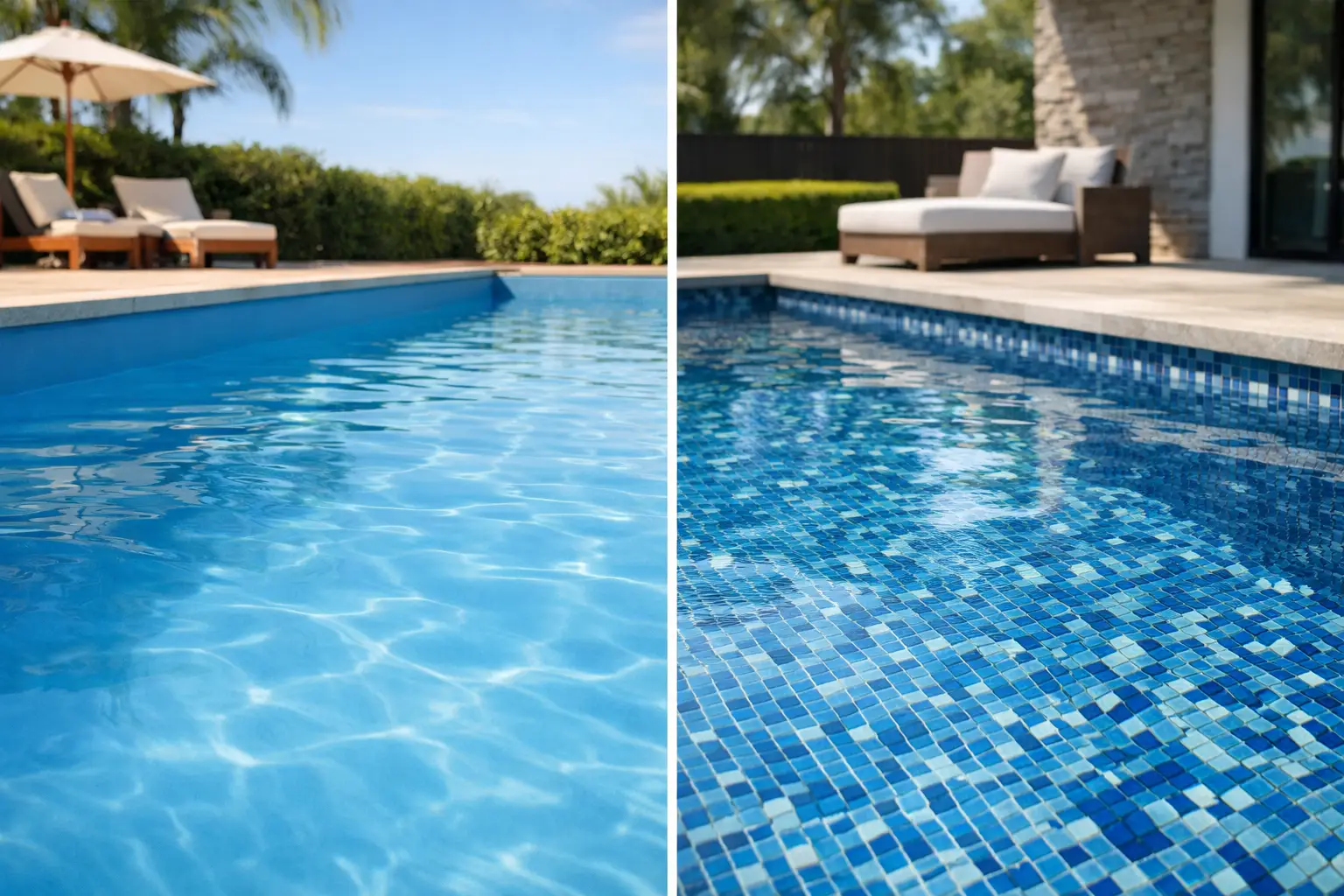
If you are planning a new pool or renovating an older one, the reinforced liner pool versus tiled pool question usually comes up early – and for good reason. The finish you choose affects not only the appearance of the pool, but also the budget, maintenance routine, repair options and long-term value of the property. In the Algarve, where pools are a central part of daily living and holiday use, that choice deserves careful thought.
For some owners, the answer is simple. They want the refined look of mosaic or ceramic and are happy to invest more upfront. Others want a clean finish, a quicker installation and a practical renovation route that keeps costs under control. Both options can work very well. The right decision depends on how you use the pool, how much maintenance you want to take on and what level of finish matters most to you.
Reinforced Liner pool versus tiled pool: the main difference
A reinforced liner pool uses a fitted waterproof membrane as the internal finish. This Reinforced liner sits against the pool structure and creates the watertight surface. A tiled pool, by contrast, uses ceramic, porcelain or glass mosaic tiles fixed onto a prepared shell, with grout joints between them.
That difference sounds technical, but in practice it changes almost everything. A reinforced liner gives a smoother, softer feel underfoot and tends to be faster to install, especially in renovation work. A tiled pool offers a more architectural and premium appearance, with greater freedom in colours, patterns and detailing.
Neither option is automatically better. One is usually better for a specific property, budget or usage pattern.
Cost and installation: where most decisions begin
For many clients, price is the first filter. In general, a reinforced liner pool is more affordable at the start than a tiled pool. Installation is typically quicker, and renovation projects can often be completed without the same level of substrate preparation needed for tiles.
This matters when an existing pool has an aged finish, minor cosmetic deterioration or waterproofing concerns. In many cases, fitting a reinforced liner can transform the pool with less disruption and a more controlled budget.
A tiled pool usually requires a higher initial investment. The shell preparation has to be right, the tile application must be accurate, and the finish work takes time. Materials also vary significantly in price, particularly with higher-end mosaics. For homeowners building a long-term residence or premium rental property, that cost may be justified by the final appearance and perceived value.
If speed is important, reinforced liners often have the advantage. If visual impact is the priority, tiles tend to lead.
Appearance and style
This is where preferences become personal. A tiled pool has a more bespoke look and can be tailored with far greater precision. You can create elegant uniform finishes, decorative borders, modern large-format effects or classic mosaic designs that suit the architecture of the property.
For villas, boutique accommodation and higher-end developments, tiles often align well with a premium design brief. They can elevate the entire outdoor area and create a stronger visual connection with terraces, façades and landscaping.
A reinforced liner pool is more limited in decorative possibilities, but that does not mean it looks basic. Modern reinforced liners are available in attractive colours and patterns, and many owners prefer their clean, consistent finish. In a private family home, especially where practicality matters as much as appearance, a liner can look smart and well-finished without pushing the project into a higher cost bracket.
The question is not whether one looks good and the other does not. It is whether you want simplicity and efficiency or a more tailored visual result.
Maintenance and day-to-day use
Pool ownership is easier when the finish works with your routine rather than against it. In this area, there are trade-offs.
A reinforced liner surface is smooth and non-abrasive, which many bathers appreciate. It can also be easier to brush in day-to-day care because there are no grout joints. However, liners are more vulnerable to punctures, cuts and accidental damage from sharp objects or poor pool practices. They also require care with chemical balance. If water chemistry is neglected, the material can fade, wrinkle or deteriorate sooner than expected.
A tiled pool is generally more resistant to surface damage during normal use. It stands up well over time when installed correctly and maintained properly. But tiles come with grout lines, and these areas can attract algae, scale and staining if the pool is not regularly cared for. Individual tiles can also come loose if there are movement issues or ageing in the substrate.
For holiday homes and rental properties, this point deserves attention. If maintenance is not always consistent, the finish should match the level of ongoing care available. A beautiful tiled pool still needs disciplined maintenance. A reinforced liner pool is not maintenance-free either, but it may simplify some aspects of regular cleaning.
Durability and lifespan
When clients ask which option lasts longer, the honest answer is that tiled pools usually have the longer potential lifespan, but only if the installation is done properly from the start.
A quality tiled finish can perform for many years and continue to look excellent, especially in well-built pools with stable structures. It is often seen as the more permanent solution. That said, repairs to tiled finishes can be more specialised, and if movement, cracking or widespread detachment occurs, rectification can become costly.
A reinforced liner has a shorter service life. It is a durable solution, but not a permanent one in the same way tile is intended to be. At some point, liner replacement should be expected as part of the lifecycle cost. For many owners, that is perfectly acceptable because the lower initial investment and simpler refurbishment route make financial sense.
So if your priority is maximum longevity and a long-term premium finish, tiles may be the better fit. If you prefer a practical system with predictable replacement over time, a reinforced liner can still be a very sound choice.
Repairs and renovation scenarios
This is one of the most overlooked parts of the reinforced liner pool versus tiled pool decision. New builds are one thing. Renovations are another.
For an older pool with surface wear, staining, failed waterproofing or an outdated appearance, a reinforced liner can be an efficient renovation solution. It allows the structure to be refreshed without necessarily carrying out a full tile restoration. In many cases, this reduces project time and avoids more invasive work.
Tile repairs can be straightforward when the issue is localised, such as a small area of detached or damaged tiles. But matching older tiles is not always easy, and underlying structural or waterproofing problems can complicate what first appears to be a simple repair.
This is where experienced assessment matters. The right finish is not just about preference. It depends on the condition of the existing shell, the intended use of the pool and the level of investment that makes sense for the property.
Which option suits Algarve properties best?
In the Algarve, pools are exposed to strong sun, regular seasonal use and, in many homes, periods of lower winter activity followed by intense summer demand. That makes material choice especially important.
A tiled pool often suits high-end villas, architect-designed homes and properties where the pool is a statement feature. It can also add appeal in premium holiday accommodation where presentation has a direct effect on guest perception.
A reinforced liner pool is often an excellent option for private family homes, practical renovations and owners who want to modernise a pool without committing to the cost of a full tiled finish. It can also be a sensible choice where speed and controlled budgeting are priorities.
The best result comes from matching the finish to the property, not from assuming there is one correct answer for every project.
How to choose between a reinforced liner pool and tiled pool
Start with three questions. How long do you plan to keep the property? How important is the design finish compared with the total budget? And how much value do you place on straightforward renovation and replacement options later on?
If you are creating a long-term home and want a premium, tailored look, a tiled pool often justifies the extra investment. If you want a smart finish, a faster installation and a more economical route for construction or renovation, a liner may be the stronger option.
The key is to look beyond the surface. The cheapest option upfront is not always the best value, and the most expensive finish is not always necessary. Good advice comes from assessing the whole pool lifecycle – build, use, maintenance, repair and future updates.
At POOLSHOP ALGARVE, that is exactly how projects should be approached. A pool is not only built or renovated for today. It has to work well for years, suit the property properly and remain practical to maintain.
A well-chosen pool finish should feel right every time you look at it, use it and maintain it. That is usually the clearest sign you made the right decision.
For a free quotation call our expert team on Tel:915244816 or email: poolshopalgarve@outlook.pt today!