
A pool can lose far more water to evaporation than most owners expect, especially in the Algarve where heat, wind and long sunny periods work against you. The best solutions to prevent pool evaporation are not just about topping up less often – they also reduce heat loss, lower chemical consumption and help protect the overall running cost of the pool.
For homeowners, holiday property managers and residential developments, this matters more than it first appears. When water evaporates, the pool does not only lose volume. It also loses warmth, balance and efficiency. That means more refilling, more heating, more chemical correction and, over time, more strain on the whole system.
Why pool evaporation becomes expensive
Evaporation is a natural process, but in outdoor pools it can accelerate quickly. High air temperature, direct sun, low humidity and wind across the water surface all increase water loss. In coastal and exposed areas, even a well-built pool can suffer significant evaporation if it is left unprotected.
The financial effect is usually spread across several small costs, which is why it is often underestimated. Replacing lost water raises water bills. Reheating replacement water increases energy use. Rebalancing chemicals after frequent top-ups adds another ongoing expense. If the pool is part of a rental property, inconsistent temperature and water level can also affect the guest experience.
There is another point that many owners miss. If water levels drop too often, skimmers and circulation performance can be affected. That can create avoidable wear in the filtration system and reduce the quality of daily operation.
Best solutions to prevent pool evaporation in real conditions
The most effective approach is usually not a single product, but a combination of practical measures matched to the way the pool is used. A private family pool, a holiday let and a shared residential pool may all need different solutions.
Pool covers are the most effective option
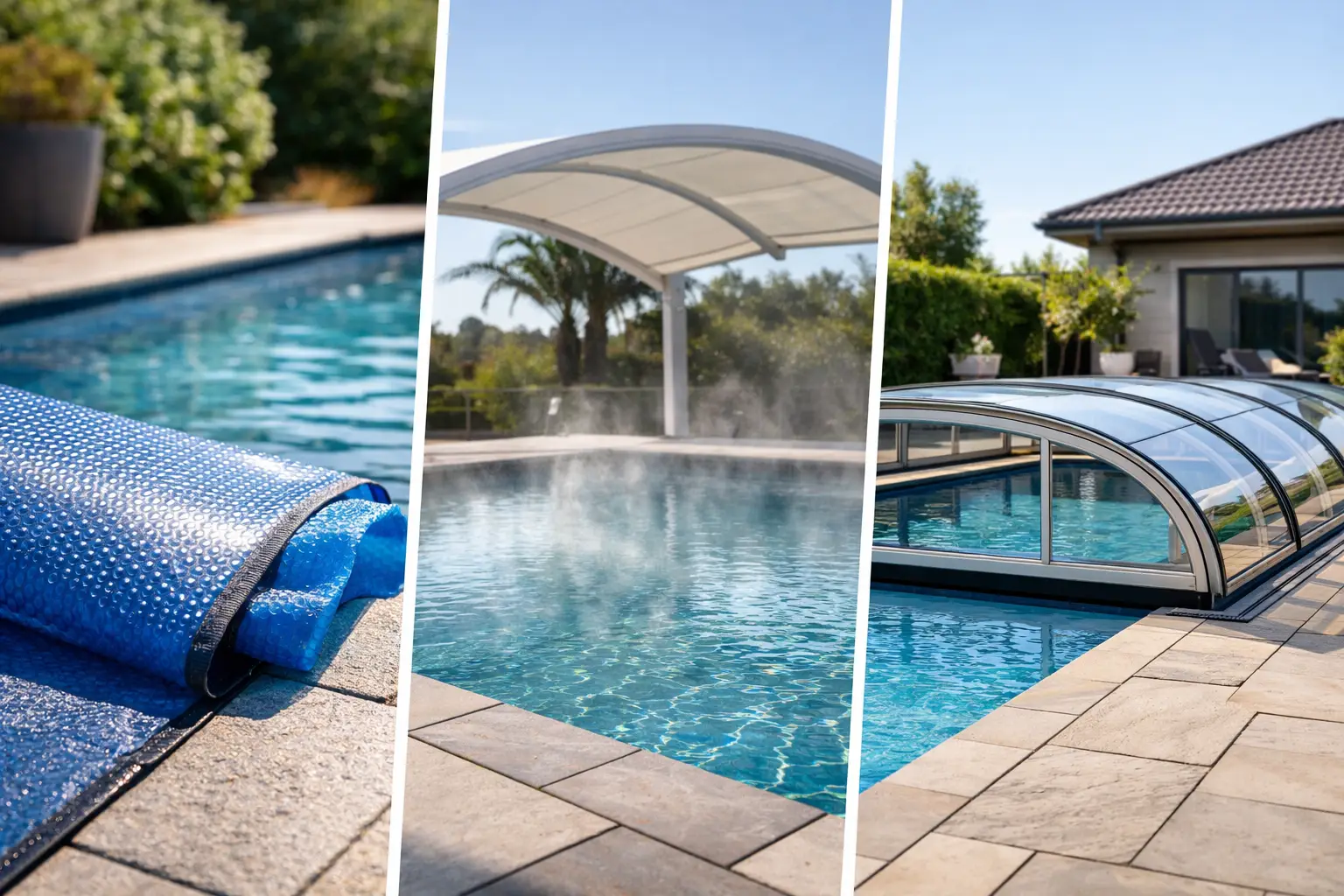
If you want the single best answer, it is a cover. A properly selected pool cover creates a physical barrier between the water and the air, which sharply reduces evaporation. In many cases, it can also help retain heat overnight and keep debris out of the pool.
For outdoor pools, this is usually the most reliable and cost-effective long-term measure. Bubble covers are a common option for owners who want a practical and accessible solution. They are especially useful during the swimming season because they are simple to use and can noticeably cut both evaporation and heat loss.
For clients looking for a more durable and integrated finish, automatic or rigid covers can be an excellent upgrade. They require a higher initial investment, but they offer stronger performance, easier daily handling and a cleaner visual result. In higher-value residential properties or tourist accommodation, that extra convenience often justifies the cost.
The trade-off is simple. A cover only works properly if it is used consistently. If it is awkward to remove or replace, people tend to stop using it. That is why the right cover is not just the one with the best technical performance, but the one that suits the routine of the property.
Reduce wind exposure around the pool
Wind is one of the main drivers of evaporation, and it is often overlooked because it feels less obvious than direct sun. When air moves continuously across the water surface, evaporation speeds up. In exposed gardens, rooftop areas or open developments, the effect can be substantial.
Landscaping can help. Strategic planting, fencing, glass screens or other windbreak features can reduce air movement over the water without making the area feel closed in. This needs to be planned carefully. The aim is to protect the pool, not create a maintenance problem with excessive leaf drop or awkward access.
In practice, this solution works best as a support measure rather than a replacement for a cover. It can improve comfort around the pool area and reduce evaporation pressure, but it will not match the performance of a physical cover over the water.
Keep water temperature under control
The warmer the water, the faster it tends to evaporate, especially when evenings are cooler or breezes pick up. That does not mean pool owners should avoid heating. It means heating should be managed intelligently.
A heat pump is often a sensible option for maintaining comfort with better energy efficiency, but the real saving comes when heating is combined with a cover. Without a cover, much of the retained warmth disappears overnight together with the water vapour. With a cover in place, the system works more efficiently and the desired temperature is easier to maintain.
For pools that are heated mainly for guest use or seasonal occupation, programming matters as well. Heating a pool constantly when it is not in use can increase evaporation unnecessarily. Matching temperature settings to occupancy patterns gives better control over both energy and water loss.
Lower unnecessary water movement
Features such as waterfalls, deck jets and decorative overflows can look impressive, but they also increase exposure to air and encourage evaporation. This is not always a reason to remove them, especially in design-led projects, but it is worth understanding the trade-off.
If the priority is reducing water loss, these features should be used selectively rather than continuously. The same applies to excessive splashing from play zones or strong return jets positioned too close to the surface. In some pools, simple adjustment of circulation settings can help reduce loss without affecting water quality.
This is one of those areas where balance matters. A pool should still suit the property and the people using it. The goal is not to strip away every feature, but to avoid waste where it serves no practical purpose.
When liquid solar covers are worth considering
Liquid solar covers are chemical products designed to form a very thin, invisible layer on the water surface. They can reduce evaporation to a degree, and some owners see them as an easy alternative to a traditional cover.
They do have a place, but they should be viewed realistically. Their performance is generally more limited than a physical cover, particularly in windy conditions or pools with high water movement. They may be useful where a normal cover is not practical, or as an additional measure in certain cases, but they are rarely the best primary solution for an outdoor Algarve pool.
For owners who want dependable, visible results, a proper cover remains the stronger choice.
The right solution depends on the type of property
A permanent residence usually benefits from a straightforward routine: efficient heating, stable water treatment and a cover that is easy to use every day. In this setting, the main goal is consistent comfort and lower running cost across the season.
A second home has slightly different priorities. If the property is unoccupied for periods, evaporation control becomes part of broader pool protection. The cover needs to be reliable during absences, and the equipment should support efficient maintenance between visits.
For tourist accommodation, convenience and presentation are equally important. The pool must stay attractive, safe and ready for use, while operating costs remain under control. Here, durable covers and well-planned equipment upgrades can make a clear difference over time.
Larger residential or hospitality settings may need a more technical assessment. Exposure, usage patterns, heating demand and maintenance schedules all influence which combination of solutions offers the best return.
Common mistakes that make evaporation worse
One common mistake is assuming that frequent refilling solves the issue. It only masks the problem while increasing costs. Another is investing in heating without protecting the water surface, which often means paying to replace lost heat again and again.
Some owners also choose a cover based only on price, then find it inconvenient to use. That usually leads to poor day-to-day adoption. A cheaper cover that stays rolled up most of the time is not a saving.
There is also the temptation to treat evaporation as unavoidable because of the climate. While some water loss will always occur, excessive evaporation can usually be reduced significantly with the right setup.
A practical approach for Algarve pool owners
In most cases, the best results come from three decisions made together: install a suitable pool cover, reduce exposure to wind where possible, and make sure heating and circulation are not working against you. That combination addresses the main causes of evaporation without overcomplicating pool ownership.
For properties where comfort, appearance and long-term efficiency all matter, it is worth looking at evaporation as part of the whole pool system rather than an isolated problem. Covers, heating, filtration and surrounding design all influence one another.
With more than 30 years of experience in pool construction, renovation and equipment supply, POOLSHOP ALGARVE helps clients choose solutions that fit the property properly, not just the catalogue. When the right measures are in place, evaporation becomes easier to control, operating costs become more predictable and the pool remains more enjoyable to use throughout the season.
If your pool is losing water faster than it should, the best next step is not another top-up – it is choosing a solution that stops the loss at source.
Contact our team of experts to help you make the right choice today. Tel: 915244816 or Email: poolshopalgarve@outlook.pt