

Choosing the depth of a swimming pool seems simple until the question that really defines the project arises: what is the ideal depth for a pool? The right answer depends less on a universal measurement and more on how the pool will be used, by whom and with what expectations of comfort, safety and maintenance.
In a private property or a holiday let in the Algarve, depth influences the daily experience, construction cost, energy consumption and even ease of cleaning. For that reason, getting the decision right at this stage avoids costly regrets later.
What is the ideal depth for a home pool?
For most residential pools, the most balanced depth usually lies between 1.20 m and 1.50 m. This range meets what most homeowners look for: a comfortable pool for relaxing, cooling off, playing with the family and light swimming.
A pool of 1.20 m to 1.30 m is practical and very versatile. It allows many adults to stand in most of the area, which increases the sense of safety and makes use more relaxed. It is also often a smart choice for homes with children, provided there is always supervision.
When depth increases to 1.40 m or 1.50 m, you gain an experience closer to recreational swimming. It remains a comfortable measurement for family use, but with an environment a little more like a “classic pool”. For many villas and second homes, this range offers the best compromise between comfort and functionality.
If the aim is just leisure, light diving and socialising, an excessively deep pool rarely brings real advantage. On the contrary, it can limit use by children and less confident swimmers.
Pool use changes the ideal depth
The right depth always depends on the usage profile. A pool designed for a family with small children should not be specified in the same way as a pool for adults, a holiday villa or a project to add value to a property.
Family leisure pool
If the main idea is to enjoy hot days, relax and spend time with the family, depths between 1.20 m and 1.40 m are usually the most suitable. This solution makes getting into the water easier, improves the perception of safety and makes the pool more inviting for all ages.
For family use, a uniform depth also works well. It avoids abrupt level changes and simplifies both construction and movement in the water.
Pool for children
When children are present, safety weighs even more heavily in the decision. This does not mean creating a very shallow pool, but ensuring a depth consistent with the ages and how the space will be supervised.
In many cases it makes sense to create a shallower area or a beach entry rather than reducing the whole pool. This way, the little ones have an adaptation zone while adults retain a comfortable area for normal use.
Pool for swimming
Those who intend to swim regularly should focus more on pool length than on large depths. For recreational swimming, a depth between 1.35 m and 1.50 m is normally sufficient. What makes a difference is having linear space for consistent strokes and a design that favours water circulation.
A very deep pool does not improve recreational swimming. It only increases the water volume and, with it, the costs of heating, treatment and filtration.
Pool for diving
Here the scenario changes. If there is a real intention to dive headfirst from an elevated edge or board, the depth must be studied with much more technical rigour. It is not enough to “make it deeper”. It is necessary to analyse safety standards, basin geometry and the entry zone into the water.
In practice, this type of solution is less common in private residential pools precisely because it requires more space, greater depth and a very well calculated design.
Deep pool or shallower pool: which pays off more?
It is common to associate a deep pool with a better pool. But that idea does not always match actual use. In many homes, the pool ends up being used mainly for being in, moving around, playing and cooling off. In those cases, a moderate depth serves daily life better.
A deeper pool implies more water. More water means more filling time, more treatment products, greater demand on the filtration system and, if heated, higher energy costs. In addition, maintenance and any technical interventions can become more demanding.
From the comfort point of view, an overly deep pool can deter some users. Adults who do not feel completely at ease in the water and accompanied children tend to make less use of a very deep pool. For holiday accommodation this also matters. The more universal the experience, the easier it is to please different guest profiles.
On the other hand, an excessively shallow pool can also fail. If the water is only just above waist height throughout, the sensation can be less pleasant for adults and the suitability for light swimming is reduced. The ideal is almost always a balance.
What is the ideal depth for a holiday accommodation pool?
In holiday villas, holiday lets and tourist developments, depth should favour safety, ease of use and a low level of risk. In most of these cases, the best option continues to be between 1.20 m and 1.50 m, with a particular advantage for uniform solutions or those with a very gentle slope.
The reason is simple. In a property with rotating users, not everyone has the same confidence in the water. An intuitive, comfortable and visually balanced pool tends to work better than a pool with very deep zones without practical need.
It is also worth thinking about the operational side. A well-dimensioned pool simplifies maintenance, water quality control and consumption management. For owners and asset managers, this translates into greater predictability and fewer problems during the season.
Shape, entries and slope also matter
Depth should not be decided in isolation. The shape of the pool, the type of entry and the possible slope of the floor influence the experience as much as the maximum measurement.
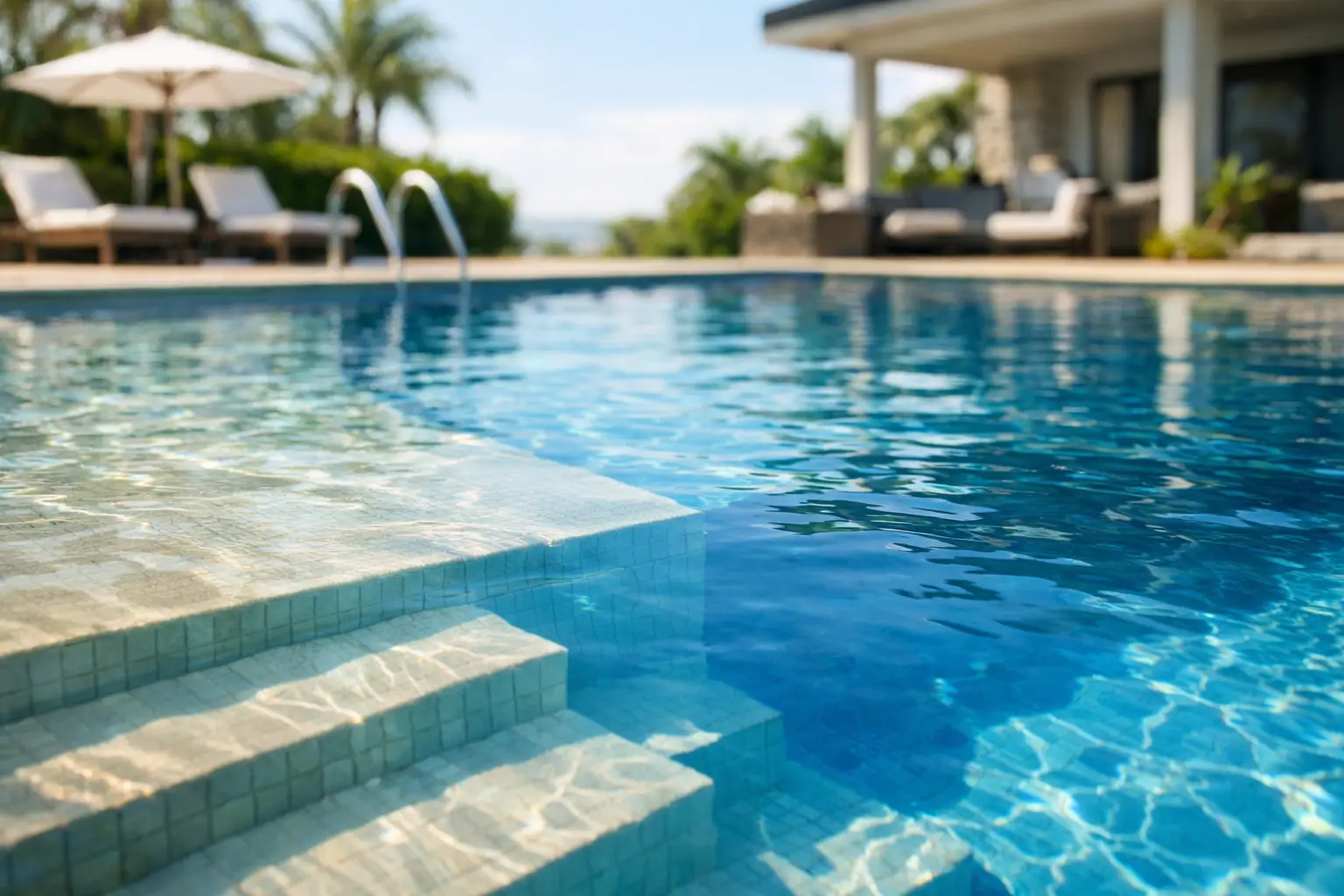
A pool with wide steps, a submerged bench or a beach entry can feel more comfortable and safer, even with a similar depth to another pool without those elements. Likewise, a completely flat floor offers a straightforward reading of the space, while an inclined floor creates transitions that can be useful in some designs but require more attention in daily use.
In refurbishments, this analysis is even more important. It is not always worth keeping old depths that were defined for usage habits that no longer correspond to the current reality of the property.
How to make the right decision without excess
Before finalising the depth, it is worth answering three practical questions. Who will use the pool most often? Is the main objective to relax, play, swim or add value to the property? And how much weight do future maintenance and energy costs carry in the decision?
When these answers are clear, the right depth appears much more easily. In most residential projects, a pool between 1.20 m and 1.50 m responds very well. In specific cases, a differentiated zone or a more technical solution may be justified, but that should come from a real need, not an aesthetic impulse.
With more than 30 years’ experience in the sector, POOLSHOP ALGARVE accompanies this type of decision in a practical way, assessing the property profile, the type of use and the technical solutions most suitable for each project.
The ideal depth is neither the deepest nor the cheapest. It is the one that makes sense for those who will use the pool, for the available space and for the level of comfort intended to be maintained over the years. When the choice is made carefully, the pool becomes more enjoyable from day one and much easier to use in the future.